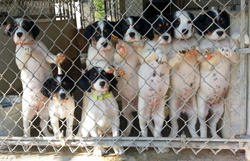
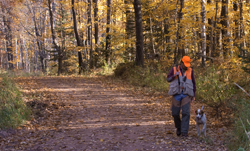
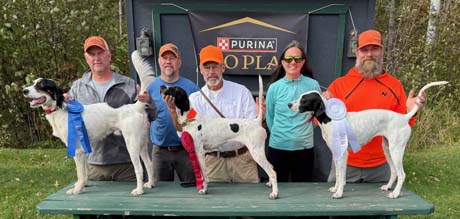
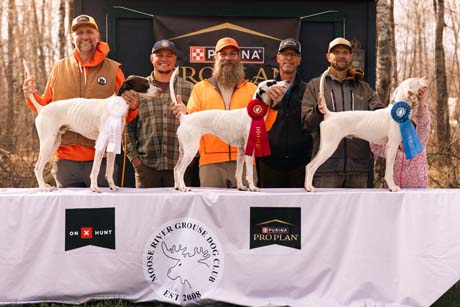
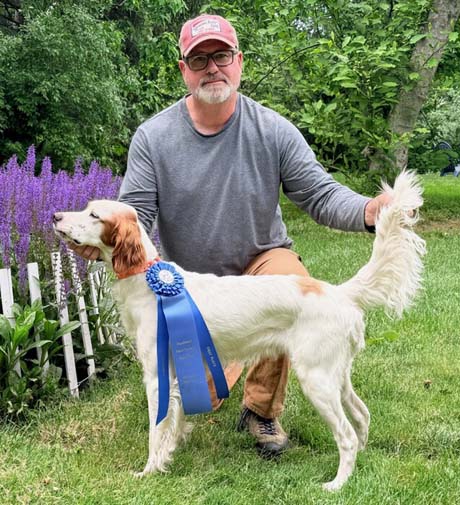
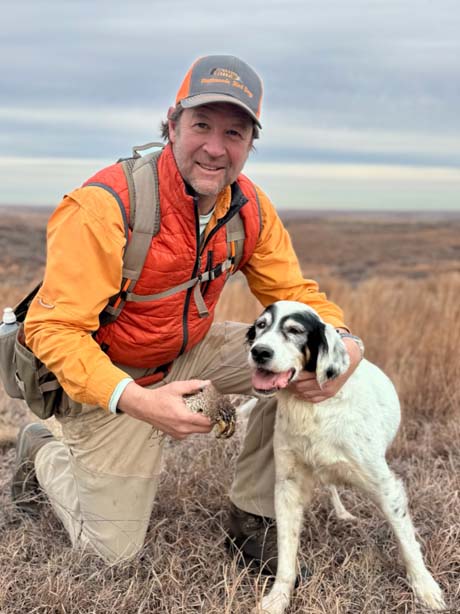
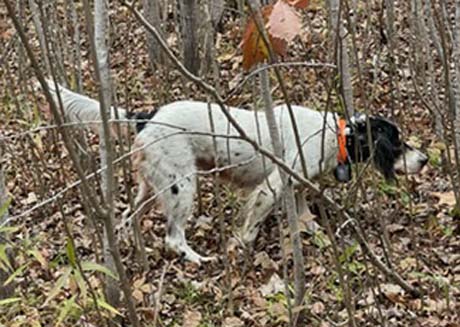
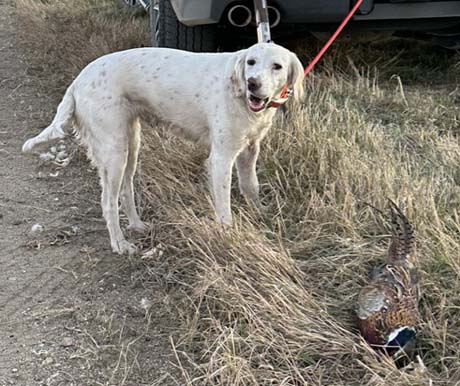
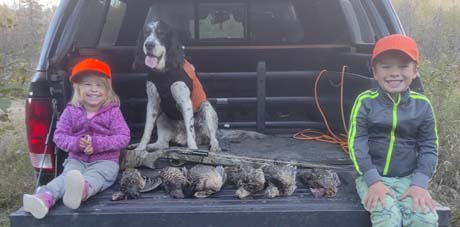
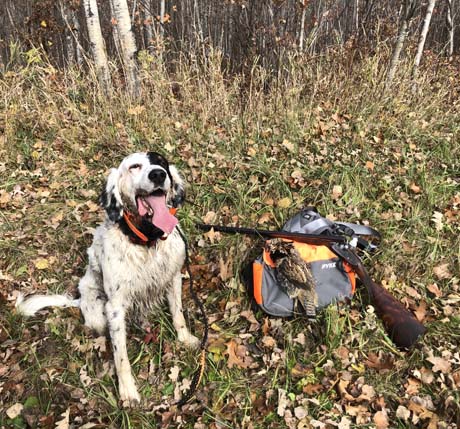
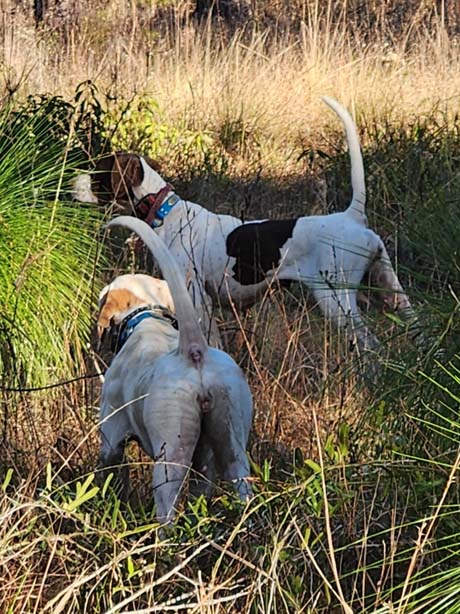
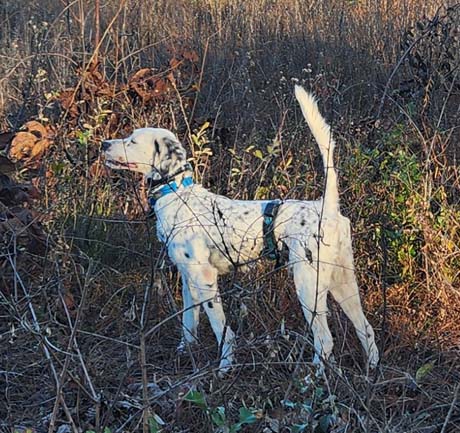
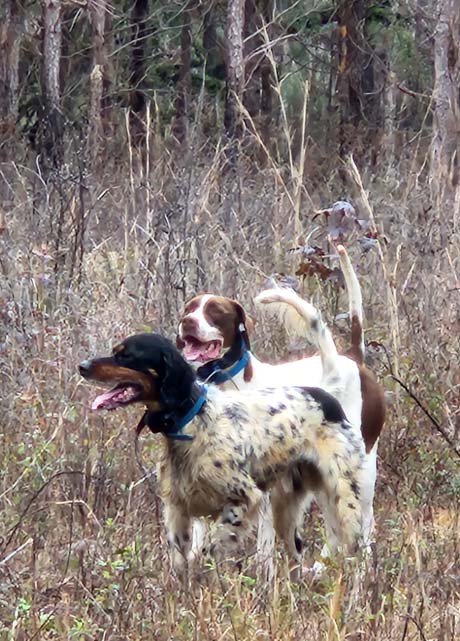
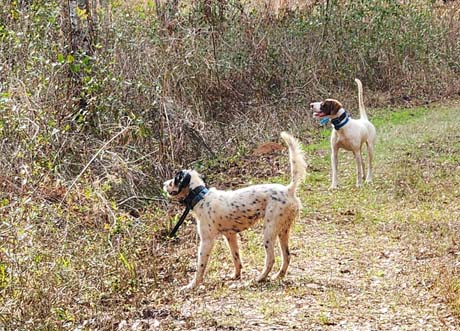
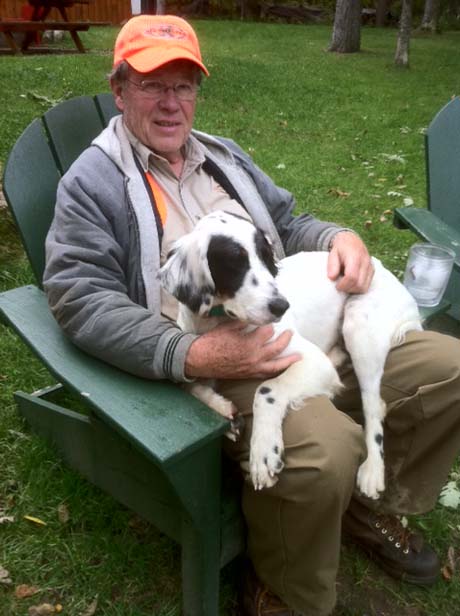
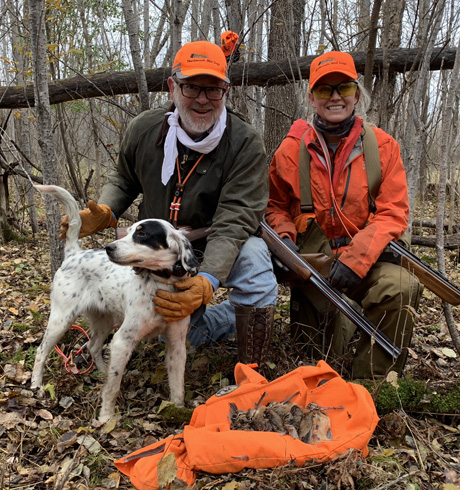
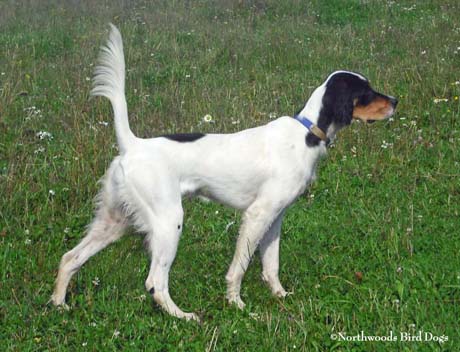
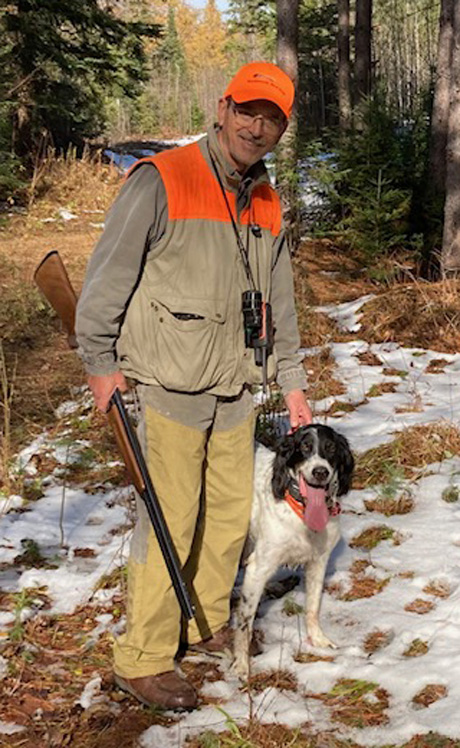
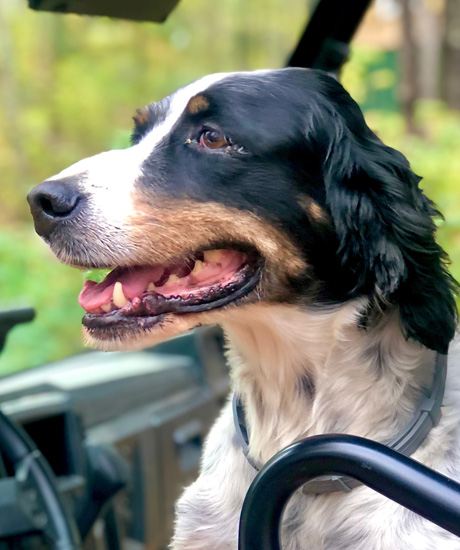
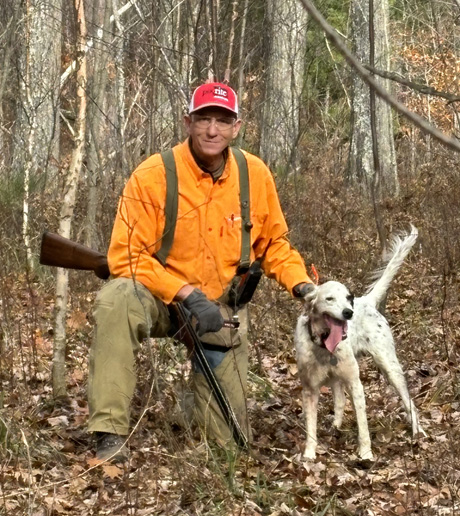
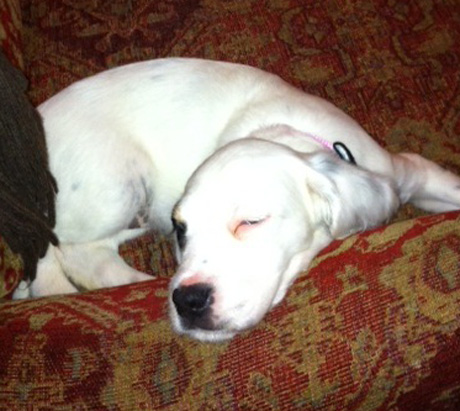
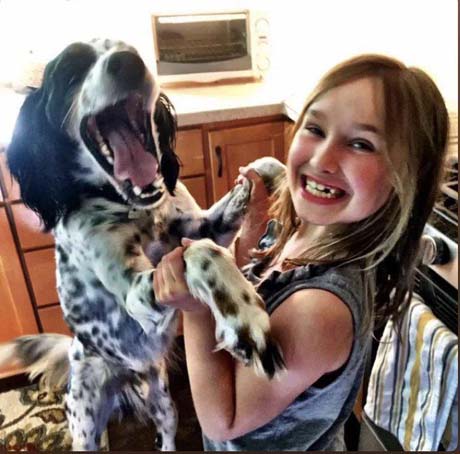
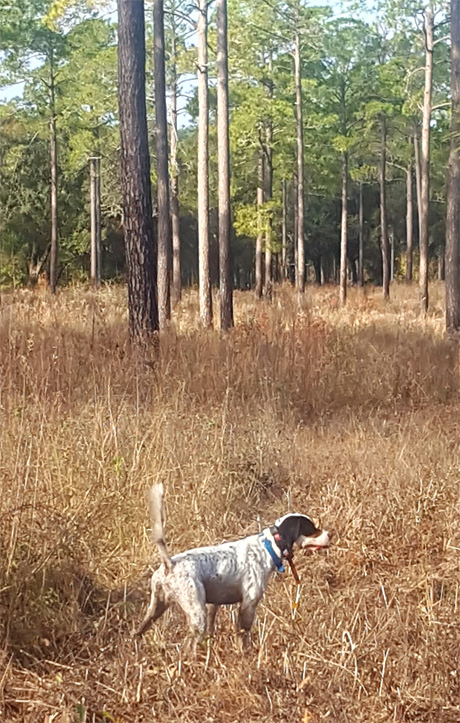
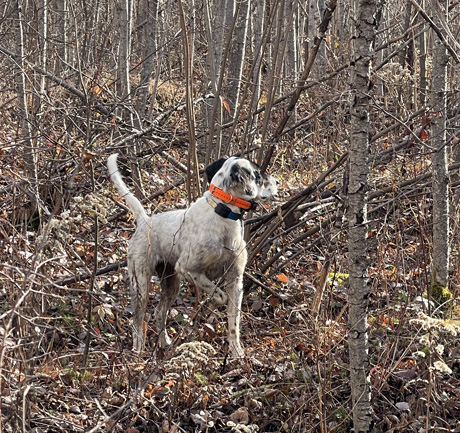
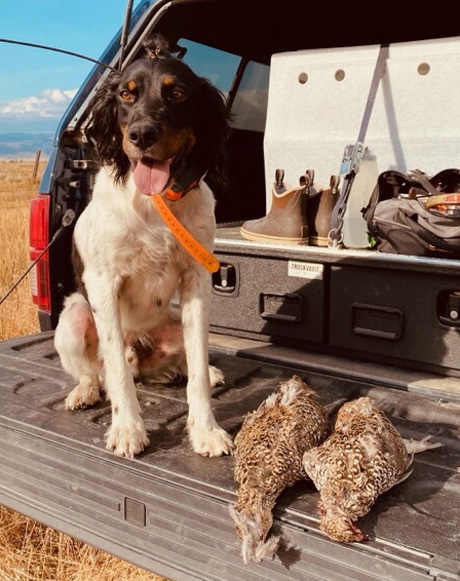
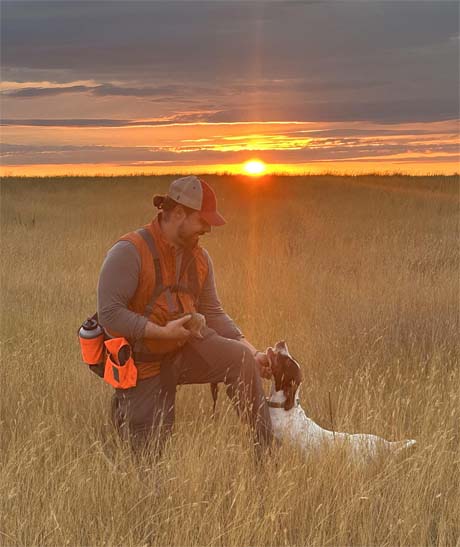
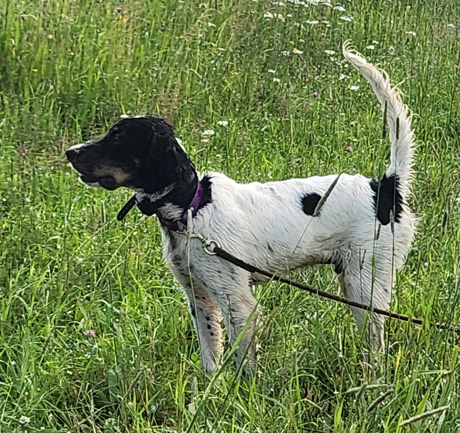
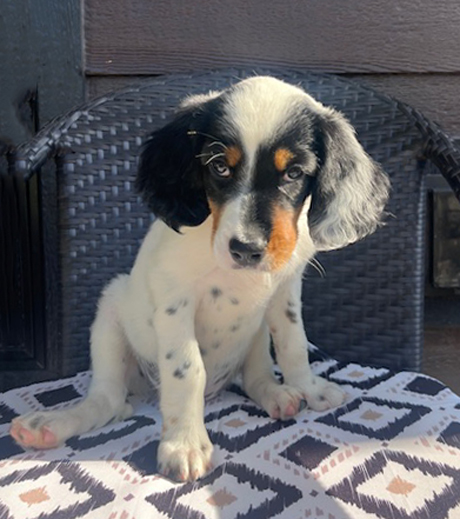
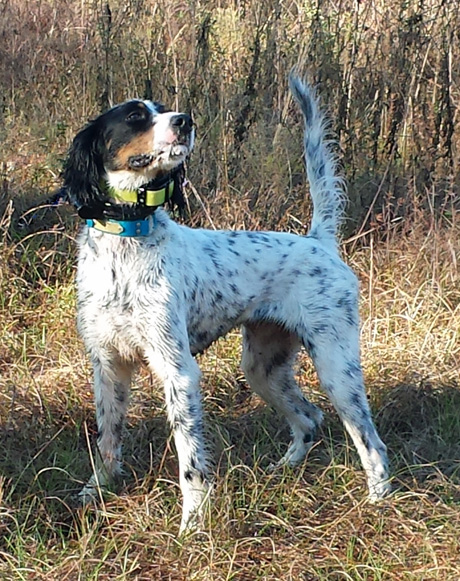
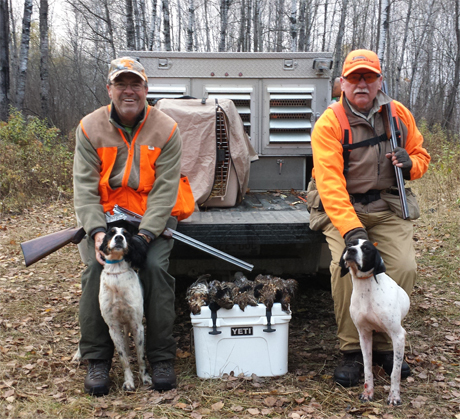
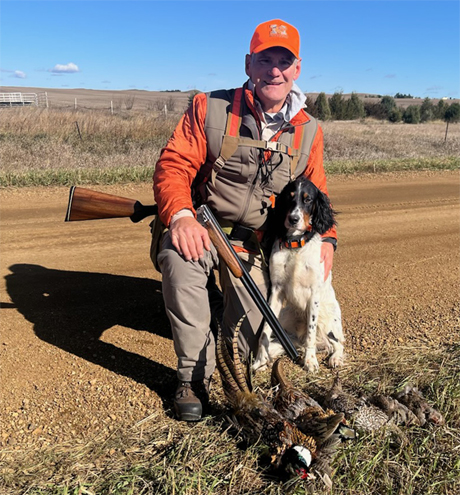
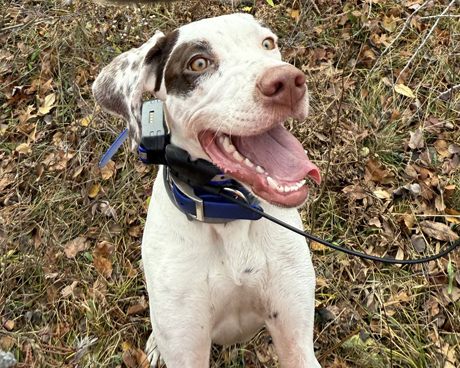
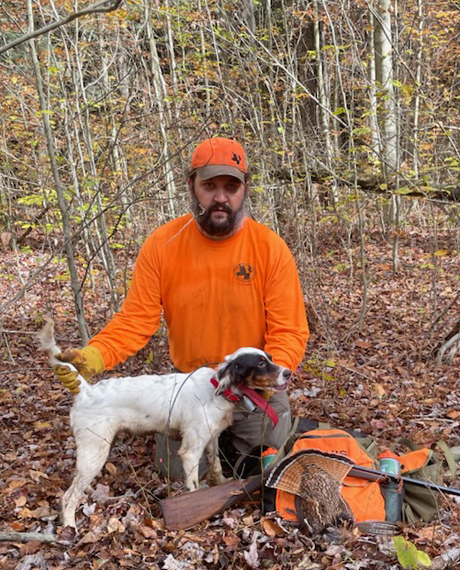
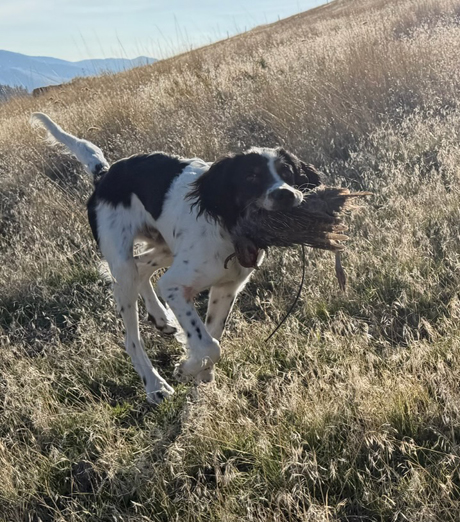
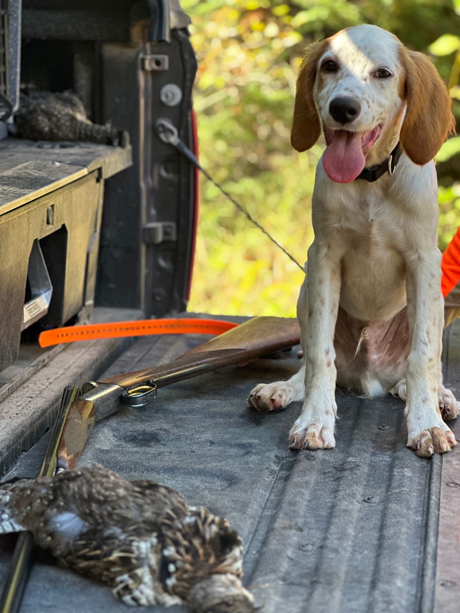
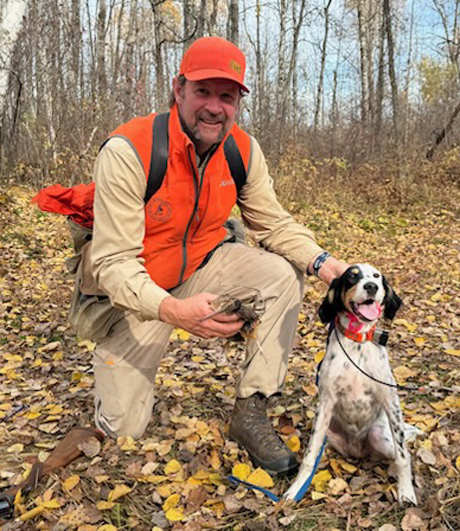
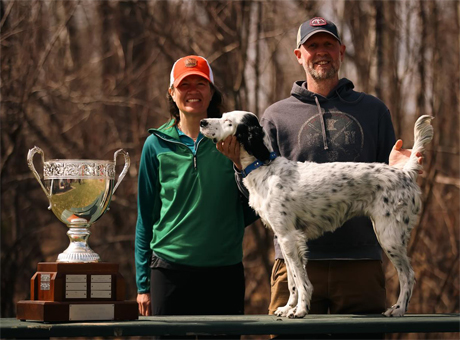
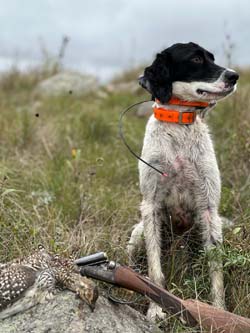
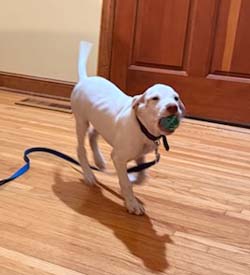
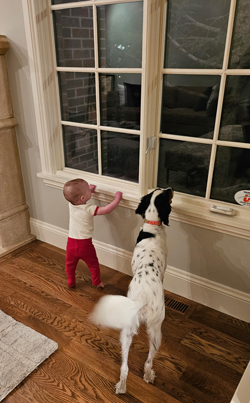
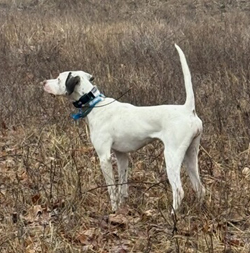
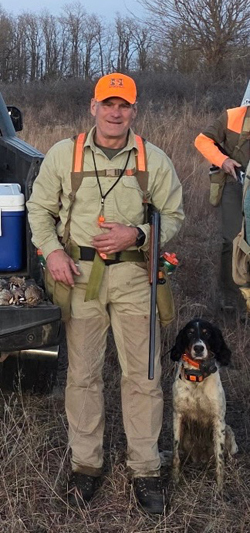
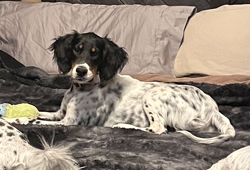
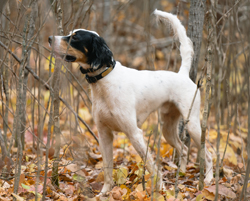
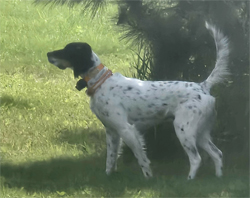
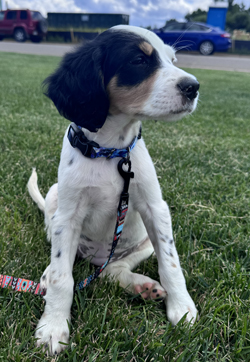
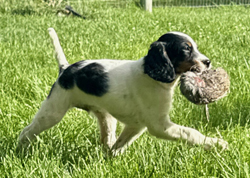
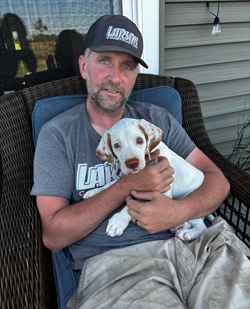
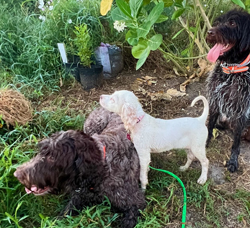
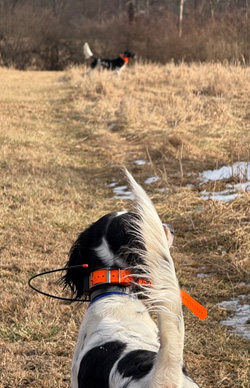
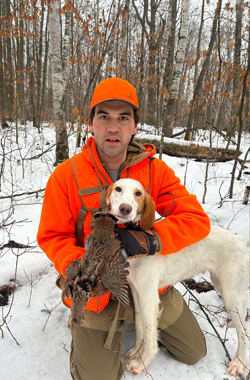
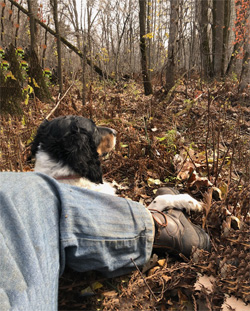
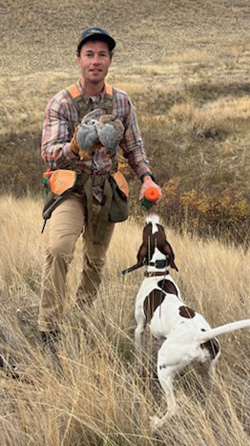
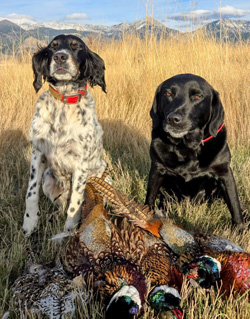
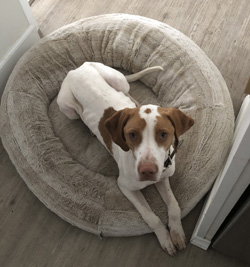
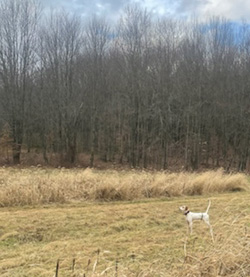
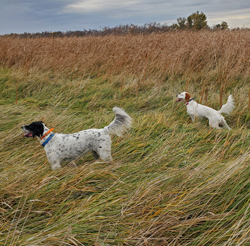
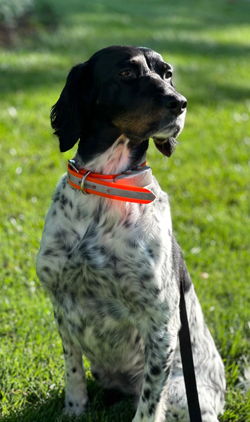
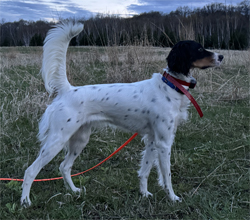
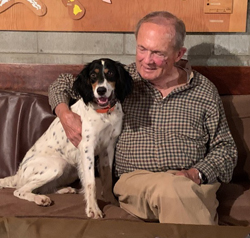
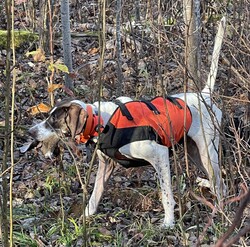
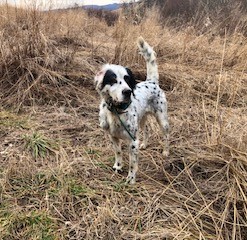
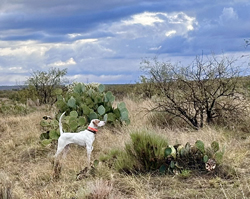
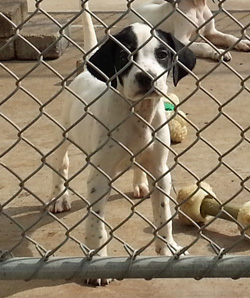
Northwoods Rip Roy (CH Woodville’s Yukon Cornelius x Northwoods Redbreast, 2024), first on left, is owned and handled by Greg Johnson of Wisconsin.
Cover dog trials are won by dogs that point grouse or woodcock and, more often than not, by dogs that point more of them than other competitors.
The ability to find and point wild birds, like all traits, starts with the dog’s genetics. These genetics include the desire to hunt for birds, the intelligence to learn birds’ haunts and habits, the “right” amount of pointing instinct, and the ability to hunt hard while also keeping track of their handler. Further, the best genetics produce a dog that does all that with a minimum amount of wild bird exposure and training.
For 30 years and through nine generations of setters and seven generations of pointers, those key traits, among others, are what Northwoods Bird Dogs has been selecting and breeding for.
But there’s another crucial component to winning field trials consistently at a high level. Owners and handlers need skill and hours of time and effort to bring out the best of their dog’s genetics. Owners and handlers of the recent winners listed below have combined that raw talent of their bird dogs with a plethora of exposure and training to earn their respective placements.
Congratulations to all owners and handlers!
FALL 2025
Northwoods Rip Roy (CH Woodville’s Yukon Cornelius x Northwoods Redbreast, 2024) Owned and handled by Greg Johnson • 1st National Amateur Grouse Championship Open Derby • 3rd Wisconsin Cover Dog Championship Open Derby
SPRING 2026
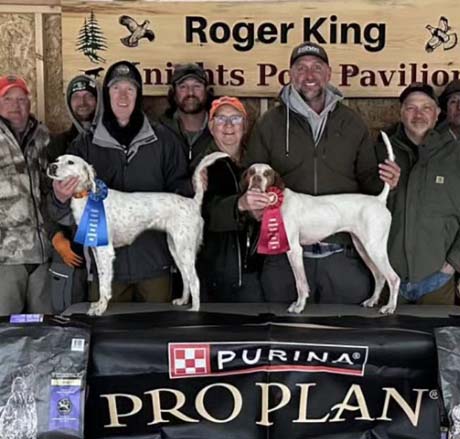
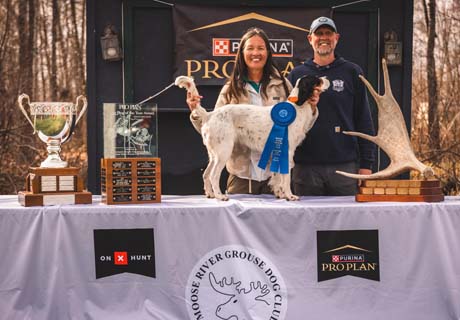
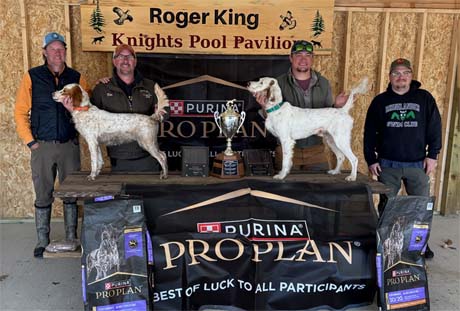
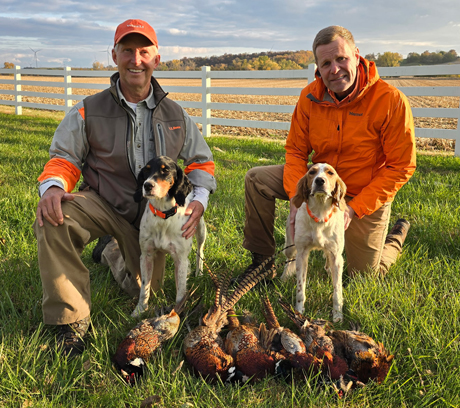
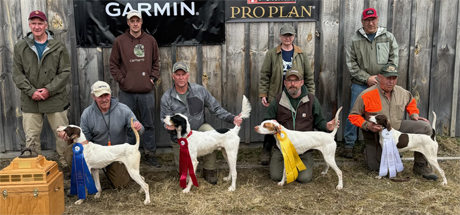
Northwoods Fallset Hope (HOF CH True Confidence x Northwoods Comet, 2021), on right, is owned by Mark Fouts of Wisconsin and pictured with handler by Josh Matel of Minnesota.
Northwoods Fallset Hope (HOF CH True Confidence x Northwoods Comet, 2021) Owned by Mark Fouts/handled by Josh Matel • 2nd Chippewa Valley Grouse Dog Association Open Shooting Dog • 3rd Moose River Grouse Dog Club Open Shooting Dog Classic
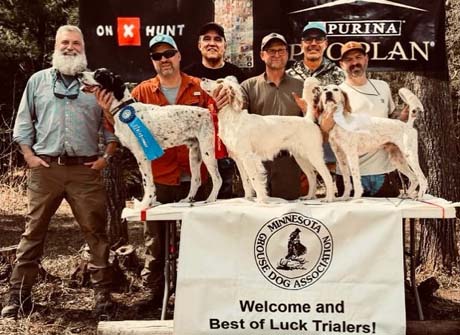
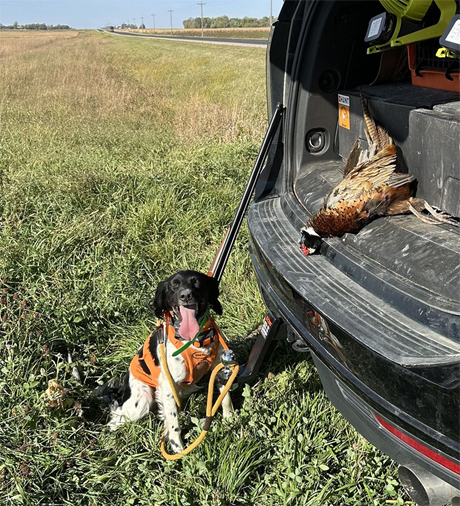
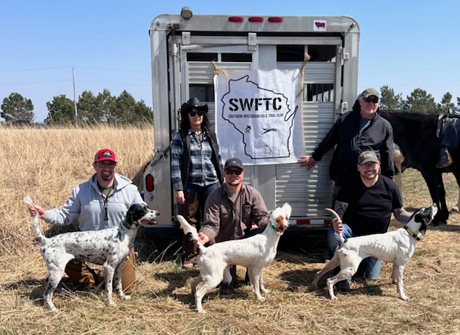
Northwoods Wanderlust (CH Confident Nation x Northwoods Comet, 2025), center, is owned and handled by Frank Ilijanic of Michigan.
Northwoods Wanderlust (CH Confident Nation x Northwoods Comet, 2025) Owned and handled by Frank Ilijanic • 1st Wolverine Field Trial Club Open Walking Derby • 2nd Beaverton Grouse Dog Club Eaton Spring Derby Classic • 3rd Grand Valley Walking Bird Dog Club Open Walking Puppy • 3rd Michigan Amateur Field Trial Club Chester Halley Memorial Amateur Derby • 3rd Ruffed Grouse Field Trial Club Bernie Bauman Memorial Open Puppy
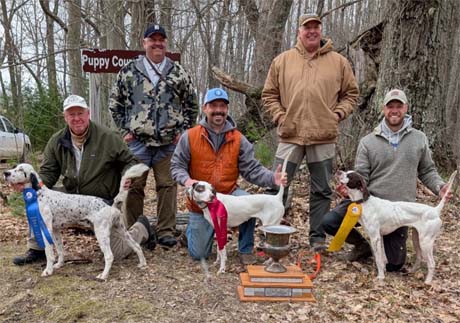
CH/RU-CH Northwoods Sir Gordon (RU-CH Erin’s Prometheus x Northwoods Carly Simon, 2016), on left, is owned by Ben McKean, on left and was handled by Ryan Hough. Both are from Minnesota.
CH/RU-CH Northwoods Sir Gordon (RU-CH Erin’s Prometheus x Northwoods Carly Simon, 2016) Owned by Ben McKean and handled by Ryan Hough • 1st Minnesota Grouse Dog Association Open Shooting Dog
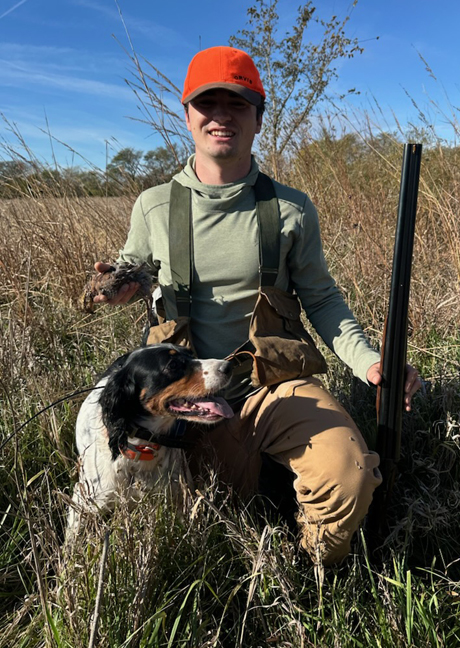
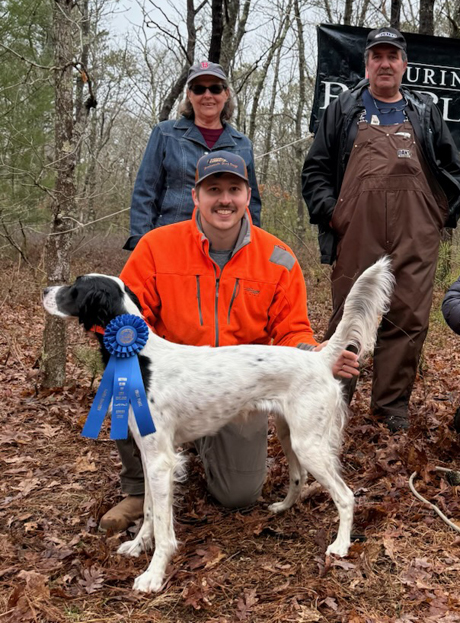
Northwoods Tyler (CH Millers’ Upgraded Version x Northwoods Comet, 2024), on left, is owned and handled by Josh Matel of Minnesota.
Northwoods Tyler (CH Millers’ Upgraded Version x Northwoods Comet, 2024) Owned and handled by Josh Matel • 3rd Moose River Grouse Club Classic Open Derby
Northwoods Orion (RU-CH Northwoods Homer x Northwoods Four Roses, 2025) is owned by Mike Powers and was handled by Lars Totten. Both are from New Jersey.
Northwoods Orion (RU-CH Northwoods Homer x Northwoods Four Roses, 2025) Owned by Mike Powers / handled by Lars Totten • 1st Setter Club of New England Amateur Puppy
Note: The championship placement of RU-CH Northwoods Homer has been featured in a previous post. Likewise, the Minnesota/Wisconsin Dog of the Year awards for Northwoods Cedar Edge and Northwoods Peregrine have been previously posted.
Fun fact: Three of the winning dogs are pointers. The dogs are all out of our Northwoods Comet but are by three different sires.
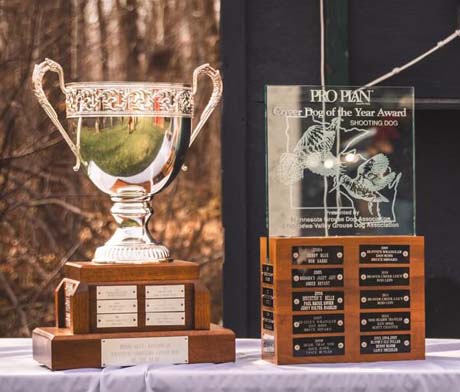
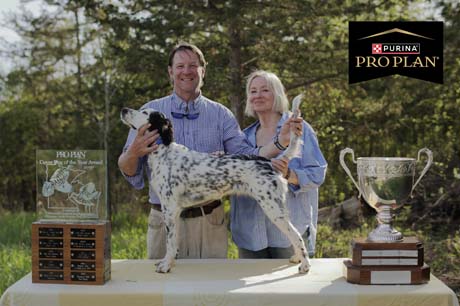
Winning is always fun but who wouldn’t relish these gorgeous trophies?
What a trial season for two young Northwoods dogs and their owners/handlers!
We are extremely proud of Northwoods Cedar Edge (call name Enni), owned by Eric and Lindsey Saetre of Minnesota, and Northwoods Peregrine (call name Poppy), owned by Chris Bye and Roberta Scherf of Wisconsin. Both dogs won Minnesota/Wisconsin Dog of the Year (DOY) awards.
The DOY awards are jointly administered by three field trial clubs, Minnesota Grouse Dog Assoc., and two Wisconsin clubs—Chippewa Valley Grouse Dog Assoc. and Moose River Grouse Dog Club. The awards are based on accumulation of points earned over a fall-to-spring trial season. Points are based on placements won and number of dogs per stake.
Being honored with these awards involves winning multiple trials, on different grounds, in different states, over a roughly six-month period. Other variabilities include judges, courses, bracemates, time of day, weather conditions and availability of wild birds. The odds can seem insurmountable.
Northwoods Cedar Edge (CH Snyder’s Pioneer Scout x CH Northwoods Cedar, 2022) won both the Open and Amateur Shooting Dog Minnesota/Wisconsin Cover Dog of the Year awards. She is owned by Lindsey and Eric Saetre.
But these two dogs prevailed. Northwoods Cedar Edge (CH Snyder’s Pioneer Scout x CH Northwoods Cedar, 2022) won both the Pro Plan Cover Shooting Dog (for professionals and amateurs) and Amateur Cover Shooting Dog DOY awards. Lindsey handled Enni and Eric scouted. Enni is no newcomer to the winner’s circle. In 2024, she won the Amateur Derby DOY.
This spring Enni, as a three-year-old shooting dog, placed in two highly competitive stakes. She earned: • 1st place: Moose River Grouse Dog Club Open Shooting Dog Classic (34 entries) • 2nd place: Minnesota Grouse Dog Assoc. Open Shooting Dog (36 entries)
Northwoods Peregrine (Cold Creek Hank x Northwoods Stardust, 2025) is the winner of both the Open and Amateur Cover Derby Dog of the Year awards. She is owned by Chris Bye and Roberta Scherf.
Northwoods Peregrine (Cold Creek Hank x Northwoods Stardust, 2025) is the winner of the Pro Plan Cover Derby (for professionals and amateurs) and Amateur Cover Derby DOY awards. Not only did she win both awards but, amazingly, Poppy is a puppy. She is handled by Chris at the trials but both Chris and Roberta have been instrumental in her development.
Poppy placed in three trials: • 2nd place: Minnesota Grouse Dog Assoc. Open Puppy • 1rst place: Minnesota Grouse Dog Assoc. Open Derby • 2nd place: North Country Shooting Dog Championship Open Derby
Congratulations to Eric, Lindsey, Chris and Roberta and their dogs for this outstanding achievement!
A final thought: Since the inception of the Minnesota/Wisconsin Pro Plan Cover Dog of the Year awards in 1994, our own Blue or Northwoods dogs, or dogs out of our breeding or dogs handled by Jerry have won 10 shooting dog and 13 derby awards.
Runner-Up Champion Northwoods Homer, on right, is posed by his owner Mitch Anderson while Tim Kaufman and his Champion Lake Effect Ali are on the left. In the back are judges Chris Bye and Alex Anderson.
Northwoods Homer (CH Snyder’s Pioneer Scout x CH Northwoods Cedar, 2022) was named Runner-Up Champion in a field of 42 dogs at the 2026 North Country Shooting Dog Championship held in April. The trial was hosted by the Chippewa Valley Grouse Dog Association and held in Wisconsin’s Eau Claire County Forest where grouse and woodcock were the quarry. The championship was judged by Chris Bye and Alex Anderson.
Homer is owned and handled by Mitch Anderson of Grand Rapids, Minn.
Homer pointed a woodcock and a grouse in his hour and finished strong. The judges were carrying Homer as champion until the final minutes of the final brace. In an exciting finish, Lake Effect Ali, owned and handled by Tim Kaufman, had a solid race with an impeccable find on a group of grouse. Ali was named Champion and Homer was named Runner-Up Champion.
Homer is Mitch’s first pointing dog—and what a pair they are. Three-year-old Homer has a powerful, stylish way of going, excellent composure around game and a penchant for finding and pinning ruffed grouse.
Congratulation to Mitch and Homer!
A special note: Betsy and I are extremely proud that Homer is the 33rd dog out of our Northwoods breeding to win a championship placement. Further, those 33 dogs have placed in more than 70 championships.
Jerry and Northwoods Vixen (CH Westfall’s Black Ice x Northwoods Prancer, 2011)
A dog lives fifteen years, if you’re lucky. ~ Mary Oliver
Jerry and I feel lucky. Vixen, the fourth of our reindeer-named pointers, will be 15 years old in a couple weeks. We’ve had many dogs, setters and pointers both, live to be 13 and 14 but Vixen is our first dog to live to age 15.
With age comes particular virtues. Words like wise and noble come to mind. My dictionary defines noble as “exalted in character…grand, stately, and magnificent in appearance.” Noble comes from the Latin nobilis which means knowable.
Noble is the perfect adjective.
We’ve noticed a few outward physical changes. Vixen’s striking orange mask has faded but, interestingly, she’s retained color on her ears. There is eyesight and hearing loss but her personality, brain, heart and nose aren’t noticeably diminished. In the woods and fields, Vixen has lost a bit of style on point but her desire hasn’t waned.
Over cocktails on a recent evening, Jerry and I started thinking about other old Northwoods dogs. A setter female came to mind as the oldest. At 16 years of age, Northwoods Highclass Kate (Northwoods Blue Ox x Houston’s Belle’s Choice) was whelped in 2010.
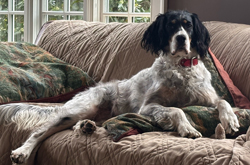
Northwoods Highclass Kate (Northwoods Blue Ox x Houston’s Belle’s Choice, 2010) ~ Barry and Jill Frieler, Minnesota
Some dogs out of Vixen inherited her longevity. Three female littermates from her breeding to Elhew G Force in 2013 are 13 years of age.
Northwoods Blue Ox was not only the sire of Highclass Kate but, through Kate, those longevity traits were passed to two littermate males that are now 14 years old. Blue Shaquille sired dogs to live to 15 and 14; and he lived to 14 years of age.
Here is a list of old dogs that we know about. We’re certain all owners would agree their dogs are noble. And that they feel lucky.
One 16-year-old setter female Northwoods Highclass Kate (Northwoods Blue Ox x Houston’s Belle’s Choice, 2010) ~ Barry and Jill Frieler, Minnesota
Besides Vixen, a 15-year-old setter male Jeter (Blue Shaquille x Houston’s Belle’s Choice, 2011) ~ Sam and Kate Gary, Colorado
Three 14-year-old setters, two of which are littermates Northwoods Rob Roy (Northwoods Blue Ox x Northwoods Chablis, 2012) ~ Chris Bye and Roberta Scherf, Wisconsin Northwoods So Crisp (Northwoods Blue Ox x Northwoods Chablis, 2012) ~ Brad and Susan Gudenkauf, Minnesota Northwoods White Russian (Blue Shaquille x Snyder’s Liz, 2012) ~ Tim and Tia Esse, Minnesota
Northwoods Rob Roy (Northwoods Blue Ox x Northwoods Chablis, 2012) ~ Chris Bye and Roberta Scherf, Wisconsin “Roy always had the ability to pace himself and as an old dog he finds his pace and keeps at it. He still gets around the woods even if I need to be a bit more selective where I run him.”
Northwoods So Crisp (Northwoods Blue Ox x Northwoods Chablis, 2012) ~ Brad and Susan Gudenkauf, Minnesota “Tana hunted right alongside RIgby this season and I was treated to many honored points by each dog. She will be in the field this October.”
Northwoods White Russian (Blue Shaquille x Snyder’s Liz, 2012) ~ Tim and Tia Esse, Minnesota “Tasha doesn’t waste energy doing young dog stuff. She has had 6 dogs come and go during her time and has gotten along with them all. She does like her solo time on the dog couch.”
13 years old: Three pointer littermates and 2 setter littermates Penny (CH Elhew G Force x Northwoods Vixen, 2013) ~Sam & Kate Gary, Colorado Ginger & Smooch (CH Elhew G Force x Northwoods Vixen, 2013) ~ Wayne Grayson, Mississippi Watson ((CH Houston’s Blackjack x Northwoods Highclass Kate, 2013) ~ Jonathon and Allison Long, Ontario, Canada Jack (CH Houston’s Blackjack x Northwoods Highclass Kate, 2013) ~ Barry and Jill Frieler, Minnesota
~ Penny (CH Elhew G Force x Northwoods Vixen, 2013) Sam & Kate Gary, Colorado
Watson ((CH Houston’s Blackjack x Northwoods Highclass Kate, 2013) ~ Jonathon and Allison Long Family, Ontario, Canada “Watson is a bit slower than he used to be but he’s still surprisingly active for his age. He got out hunting a few days last fall and his nose still works great, even though his eyes aren’t as sharp.”
Jack (CH Houston’s Blackjack x Northwoods Highclass Kate, 2013) ~ Barry and Jill Frieler, Minnesota
The #1 dog on our string is liver-and-white female pointer Northwoods Comet (HOF CH Rock Acre Blackhawk x Northwoods Vixen, 2018). She is backed by another HOF-bred pointer female, Northwoods Confidante (HOF CH True Confidence x Red Sunshine, 2022).
The quarry for Jerry, me and our dogs in southwestern Georgia near Thomasville is bobwhite quail—wild bobwhite quail.
Bobwhites are small birds that weigh only 6 ounces. They live in flocks, or coveys, of about 15 birds. For protection from both predators and hunters, bobwhites form a circle with tails pointing toward the center and heads facing out.
A particular, thrilling aspect of a bobwhite quail hunt is when a covey flushes, commonly called a rise. As David Allen Sibley explains in The Sibley Guide to Birds, coveys “flush all together at close range in an explosion of noisy wingbeats.” The rise happens fast and the birds scatter even faster.
A bird dog on point doesn’t get much prettier than Northwoods Snow Bunny (CH Ponderosa Mac x Northwoods Redbreast, 2022).
This marks the twelfth season that Jerry and I have lived in this region of Georgia. While we train a few dogs from clients, now we mostly train, develop and condition our own dogs.
Two males, Northwoods Eddie Setter (CH / RU-CH Northwoods Sir Gordon x Northwoods Valencia, 2023), in front, and Northwoods Rudolph (CH Southern Confidence x Northwoods Comet, 2023), stopped within feet of each to back another dog on point.
During the quail season, though, we work for our client who leases four-day hunts on an 11,000-acre plantation in northern Florida. The day’s schedule is dependent on weather but generally six braces of dogs are run—three in the morning and three in the afternoon. Jerry handles our dogs and an employee from the plantation handles theirs. While our string includes half pointers and half setters, 90% of the plantation’s dogs are pointers.
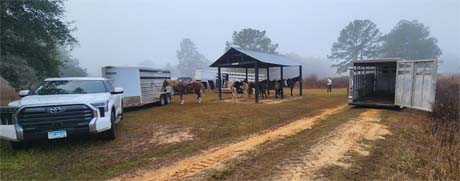
On a foggy morning in January, dog handlers meet to saddle their own horses and horses for the guests and otherwise prepare for the morning hunt.
These hunts adhere to traditions handed down through many generations of hunters. Handlers and hunters ride Tennessee walking horses and an open, customized Jeep carries dogs not being run. In addition, a pair of cocker spaniels are on board for retrieving birds.
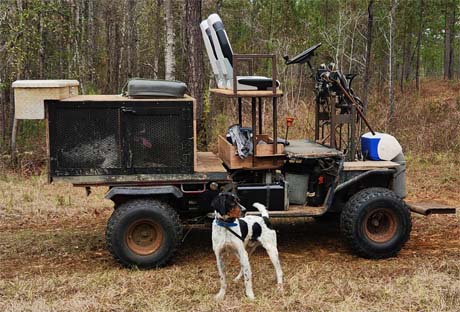
Hunts conducted on the plantation where we live are conducted off a pair of very cool, customized 30-year-old Kawasaki mules. Before the breakaway, dogs are clipped to the mule while those awaiting their turn to hunt ride in the roomy spaces under the rear bench seat.
We also handle our dogs on hunts on the plantation where we live. The owner of the plantation and her family and guests eschew horses and instead drive 30-year-old modified Kawasaki mules. A number of their dogs are brought along including, among others, Labrador retrievers and a springer spaniel.
Intensity and style on point aren’t trainable attributes. Eyes blazing and ear flipped back, Northwoods Snow Queen (RU-CH Northwoods Atlas x Houston’s Nelly Bly, 2023) points a huge covey of wild bobwhite quail.
Our main kennel building is a nicely renovated horse barn. Four large, fenced-in exercise pens are easily accessible from the kennel runs.
Running a late afternoon brace of puppies is one of our favorite things to do. Our main goal is exposure to birds—lots of birds. Northwoods Cassiopeia (Cold Creek Hank x Northwoods Stardust, 2025) has the find and Northwoods Something Royal (CH Confident Nation x Northwoods Comet, 2025) naturally backs.
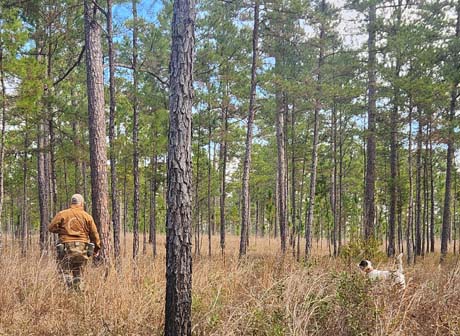
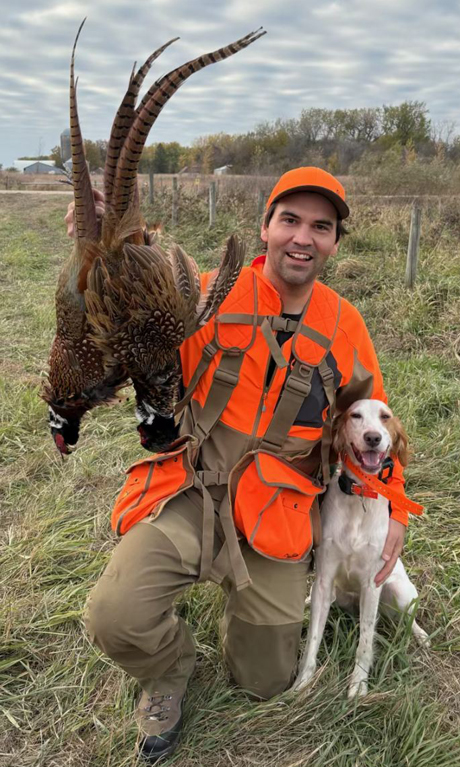
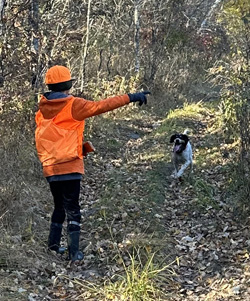
Under the classic canopy of longleaf and loblolly pines, Greg Johnson flushes for his derby Northwoods Rip Roy (CH Woodville’s Yukon Cornelius x Northwoods Redbreast, 2024).
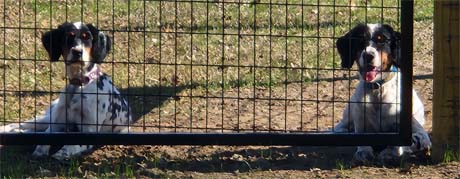
Northwoods Four Roses (CH Rufus Del Fuego x Northwoods Valencia, 2021), on right, and her daughter, Andromeda, by Northwoods Homer relax by the gate in an exercise pen.
Chuck Bye and Northwoods Venus (CH Can’t Go Wrong x Cold Creek Pearl)
To continue our tradition, Betsy and I want to honor three men and 13 dogs who passed away this year. These men were not only friends but were—in their own ways—crucial to the success of our business.
And, about the dogs. We’re grateful to their owners for the lives they gave the dogs—whether as beloved companions lounging in a favorite spot, playing with the kids or bird hunting. The ages of the dogs ranged from a 15-year-old setter female to two puppies who died far too young.
We’ll never forget these dogs pictured below. The various breedings they represent are the heart and soul of Northwoods Bird Dogs.
**********
Chuck Bye (1944 – 2025) Chuck owned New Wood grouse camp and was a passionate grouse hunter. He owned many Brittany spaniels but his favorite setter was Northwoods Venus.
Dr. Mark Nelson (1948 – 2025)
Mark was a trusted veterinarian from Wisconsin and was responsible for all the Houston frozen semen puppies.
Bob Walthall (1947 – 2025)
Bob managed the beautiful Sunny Hill Plantation outside Thomasville, Ga., and co-owned HOF CH Rock Acre Blackhawk and Blackhawk’s semen.
**********
Northwoods Camembert (Northwoods Blue Ox x Houston’s Belle’s Choice, 2010) with Ben Johnson, on left, and Ashley Heig on a guided hunt. ~ Bill and Gail Heig and Family, Minnesota
Northwoods Tesla (Northwoods Blue Ox x Northwoods Chablis, 2011) ~ Tim and Monica Cunningham, Minnesota
Northwoods Led Zeppelin (Blue Shaquille x Houston’s Belle’s Choice, 2011) ~ David and Pam Bast, Kentucky
Northwoods Carly Simon (Blue Shaquille x Houston’s Belle’s Choice, 2011) ~ Jessica and Taggart Kramer, Wisconsin
Bess (Northwoods Blue Ox x Northwoods Chardonnay, 2012) ~ Glen Gilson, Ohio
Northwoods Lucinda Belle (Northwoods Blue Ox x Northwoods Chablis, 2012) ~ Ken Johnson, Alabama
Northwoods BMW (Houston’s Blackjack x Northwoods Chablis, 2013) ~ Mike and Gil Blomquist, Minnesota
Northwoods Fen (Northwoods Blue Ox x Northwoods Chablis, 2015) ~ Harrison O’Connor, Montana
Rae (Sunny Hill Sam x Northwoods Carly Simon, 2016) ~ Gregg and Sherrie Knapp and Family, Wisconsin
Forrest (Northwoods Grits x Northwoods Minerva, 2018) ~ Jimmy Blackburn, Montana
Northwoods Flirt (HOF CH True Confidence x Northwoods Comet, 2021) ~ Frank Ilijanic, Michigan
Northwoods Blue Beech (CH Woodville’s Yukon Cornelius x Northwoods Redbreast, 2024) ~ Walter Manley, Florida & Montana
Northwoods Jazzy May (Cold Creek Hank x Northwoods Stardust,2025) ~ Robby and Tim Lockler
Northwoods Carly Simon (Blue Shaquille x Houston’s Belle’s Choice, 2011)
The theme song for the 1997 James Bond movie, “The Spy Who Loved Me,” was composed by Marvin Hamlisch and lyrics were by Carole Bayer Sager. But it was the singer Carly Simon who brought those words to life in the song, “Nobody Does It Better.”
In 2011, when our puppy naming theme was rock bands and musicians, one of the female setter puppies was named Northwoods Carly Simon. How befitting that our puppy matured into a phenomenal bird dog that expertly handled and pointed ruffed grouse. No dog did it better.
Carly was line-bred to Paul Hauge’s dog Houston, a major contributor to the early genetics of our Northwoods setter line. Carly’s sire, Blue Shaquille, was a son of Houston and her dam, Houston’s Belle’s Choice, was a granddaughter. Three times Betsy and I repeated that breeding, leading to a generation of natural bird dogs. Those dogs, in turn, had the uncommon ability to consistently pass those characteristics to their progeny.
What a morning in the grouse woods for two guiding clients. Two-year-old Carly, on left, is happy to share the spotlight with Maggie, her pointer bracemate.
Carly was the epitome of a grouse dog. She ran with lofty carriage, high head and high stiff tail. She would occasionally put her head down if scent was there but most often her head was up, nose searching for air scent. Carly had a medium-coupled build, an efficient gait and pointed with poise and intensity. She wasn’t a big ranging dog. In the grouse woods, she was within 100 yards and even on the prairie she would rarely crack 200 yards. Carly was always hunting birds and when she pointed, the birds were there.
As a young dog though, she wasn’t afraid to engage birds to try to make them sit tight resulting in quite a few bumped grouse. But once Carly figured out the distance, she invariably produced killable pointed birds with few unproductives.
Those abilities made Carly a celebrity of our grouse guiding string where—for seven years—she provided countless memorable days in the grouse woods for our clients.
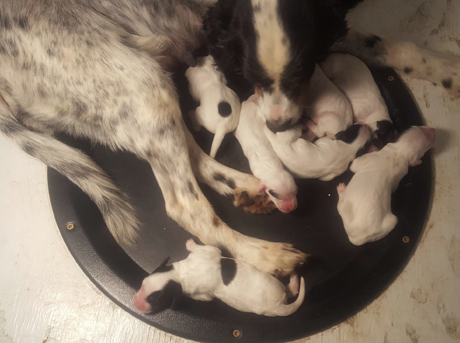
Carly cares for her one-day-old puppies by RU-CH Erin’s Prometheus in 2018. Some famous dogs are in that nest, including Madrid, Paris, Dixie and Speck.
In addition to her prowess as a bird dog, Carly excelled as a producer. In her six litters of 24 males and 22 females, she left a legacy that continues today. Our 2025 Northwoods Homer x Northwoods Four Roses litter goes back to Carly through both the sire and dam.
Carly’s early litters produced extremely nice dogs—many are still enjoying life and hunting—but when Betsy and I chose RU-CH Erin’s Prometheus (out of CH Ridge Creek Cody, a dog we bred), we hit on a “nick.” For three years in a row, we repeated the breeding and produced 21 puppies. Besides many impressive grouse dogs, two cover dog champions, CH Northwoods Sir Gordon and CH Northwoods Cedar, were whelped. Siblings Northwoods Minerva and Northwoods Stardust were stars in our guiding string. All four of those dogs have been bred and produced wonderful puppies. Other notable dogs include Northwoods Hercules in our Georgia guide string and Fitz, an extraordinary Wisconsin grouse dog.
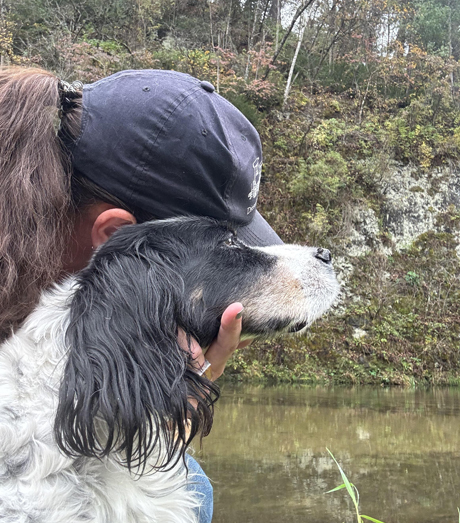
Jessica and Carly share a hug on the banks of the Kinnickinnic.
We retired Carly from breeding in 2019 and, as always, we searched for the perfect place for her best possible life. Through our friend and client, Chris Bye, we found that spot. Wisconsin residents Jessica Kramer and Taggart, her son, fell in love with Carly. For her last six years, Carly spent nights on her favorite couch and days wandering the banks of Kinnickinnic River, assisting in fly fishing whenever necessary.
But she wasn’t retired from the woods. Chris hunted her until she was almost 13 years old and they shared many memorable hunts. He commented about a first hunt with Carly: “I quickly learned if Carly pointed, the bird was there. That day she pinned 14 grouse in surgical fashion in less than two hours. It was a day you don’t soon forget, and we quickly learned to never, ever doubt Carly.”
Jessica summed up her feelings for Carly: “Thank you for allowing us to care for and love her these past six years. What a gift to me and my son she has been. She truly changed our lives.”
Carly Simon’s hit song concludes with the perfect line. “Baby, you’re the best.”
Rest in peace, sweet Carly. We will always remember.
Sage (CH Miller’s Upgraded Version x Northwoods Comet, 2024), on left, and her half-sister Juniper (HOF CH True Confidence x Northwoods Comet, 2021) ~ Joey Paxman and Amanda Allpress, Montana
By the dozens, Northwoods Bird Dogs have recently been afield across the country. No matter the age of the dog—whether young puppies whelped this year or experienced older dogs—many birds were pointed, retrieved and bagged. The photographs below are filled with blaze orange, big smiles and tired dogs.
Filly (May’s Pond Hank x Northwoods Stardust, 2024) ~ Tom and Lauren Strand Family, Minnesota
Rip (Northwoods Louis Vuitton x Houston’s Dancing Queen, 2022) ~ Mark FItchett, Kansas
Nelly, on left, and her littermate, Jones (CH Northwoods Sir Gordon x Northwoods Valencia, 2022) ~ Gregg and Sherrie Knapp Family, Wisconsin ~ Chris and Laura Miller, Illinois
Sweep (CH Northwoods Sir Gordon x Northwoods Valencia, 2023) ~ Tim Esse, Minnesota
Annie (CH Rufus del Fuego x Northwoods Valencia, 2021) ~ Chip Sligh Family, Georgia
Ruby (CH Confident Nation x Northwoods Comet, 2025) ~ Frank Ilijanic, Michigan
Sky (Northwoods Homer x Northwoods Four Roses, 2025) ~ Tom and Ashton McPherson, Pennsylvania
Will (Northwoods Homer x Northwoods Four Roses, 2025) ~ Chris and Mary Dombrowski Family, Montana
Finn (Northwoods Homer x Northwoods Four Roses, 2025) ~ Joe and Britta Parpala Family, Minnesota
Poppy (Cold Creek Hank x Northwoods Stardust, 2025) ~ Chris Bye and Roberta Scherf, Wisconsin
Smoke (Cold Creek Hank x Northwoods Stardust, 2025) ~ Mike Watson, Pennsylvania
Mace (Cold Creek Hank x Northwoods Stardust, 2025) ~ Marc Austof Family, Michigan
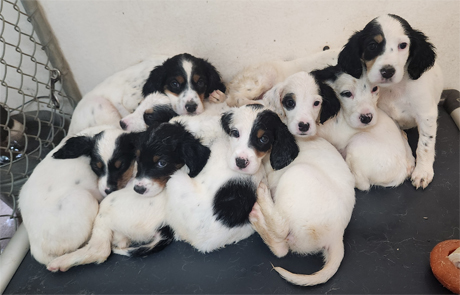
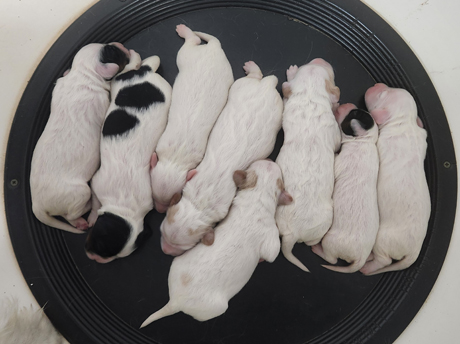
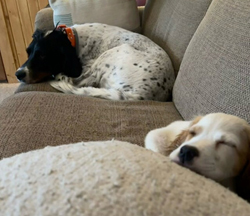
At six weeks of age, the nine puppies out of Northwoods Stardust by Cold Creed Hank still sleep in a pile.
Of the chores Jerry and I do around the kennel, some are fun and some are not so fun. In the latter category are the daily hosing of the kennel runs (Jerry) and cleaning up the play yard with a little rake and shovel (me).
However, we agree unequivocally that the most enjoyable chores involve puppies.
Four-day-old puppies out of Northwoods Four Roses by Northwoods Homer cuddle while they sleep on the heated nest.
We got a huge dose of it this spring. Comet, Stardust and Four Roses came into season within a couple weeks of each other. They were each bred and then nine weeks later whelped their litters on May 2, May 13 and May 17, respectively.
The total was 20 puppies—3 pointers and 17 setters.
Since there were only three puppies out of CH Confident Nation x Northwoods Comet and they got plenty of food, they were always substantially larger than than the other two litters.
Even though it’s our business and, as previously mentioned lots of “enjoyable” work, there is another dimension to puppy chores. Every day for eight weeks, we watch them, care for them, play with them and get to know each one individually. From the very first day when each weighs less than one pound and are totally helpless until they have grown and developed into little dogs, we watch them.
Puppies out of Northwoods Homer x Northwoods Four Roses are eight weeks old and ready to go to their new homes.
Then, in a bittersweet blink, the puppies are eight weeks old and we send them off into the world. Excited new owners drove or flew from all over the country—New York, New Jersey, Maryland, Pennsylvania, Ohio, Michigan, Illinois, Wisconsin, Minnesota, Texas and Montana—to pick up their puppy.
As each puppy left with their owner, we said, a la Gandalf, “Fare well!”
Northwoods Tyler (CH Miller’s Upgraded Version x Northwoods Comet, 2024) is owned and handled by Josh Matel.
“…there should be no distinction between a field trial dog and a shooting (hunting) dog, the former is merely the latter on public display.” ~ William Harnden Foster
We agree with Mr. Foster–especially when considering cover dog field trials. A large majority of the dogs entered in these competitions are also hunted on wild birds.
The dogs featured below perfectly exemplify our breeding goals for the past 30 years. We’ve strived to produce dogs with the physical and mental ability to compete at the highest levels of field trial competition. That those dogs win at the trials is because they excel as hunting dogs.
Here are Northwoods-bred dogs that had a phenomenal winning season.
Northwoods Cedar (RU-CH Erin’s Prometheus x Northwoods Carly Simon, 2019) is owned and handled by Eric and Lindsey Saetre.
CH Northwoods Cedar (RU-CH Erin’s Prometheus x Northwoods Carly Simon, 2019) is owned and handled by Eric and Lindsey Saetre of Minnesota. Cedar continued her success last fall with a stunning spring season. She placed in three trials in three different venues on her way to winning the 2025 Minnesota/Wisconsin Amateur Shooting Dog of the Year. • 1st Don Didcoct Amateur Shooting Dog Classic • 2nd Moose River Grouse Classic • Runner-up Grand National Grouse and Woodcock Invitational Championship (blog post detailing the Invitational)
Northwoods Tyler (CH Miller’s Upgraded Version x Northwoods Comet, 2024), owned and handled by Josh Matel of Minnesota, had a remarkable spring for a one-year-old puppy. Tyler placed over dogs up to twice his age in stakes that saw 25-32 entries. Tyler ran a mature hunting pattern and pointed grouse in three of his wins. He earned the 2025 Minnesota/Wisconsin Pro Plan Cover Dog Derby of the Year. • 1st North Country Championship Open Derby • 1st Minnesota Grouse Dog Association Open Derby (first trial) • 1st Minnesota Grouse Dog Association Open Derby (second trial) • 2nd Moose River Grouse Dog Club Open Derby
Northwoods Rip Roy (CH Woodville’s Yukon Cornelius x Northwoods Redbreast, 2024), second from left, is owned and handled by Greg Johnson.
Northwoods Rip Roy (CH Woodville’s Yukon Cornelius x Northwoods Redbreast, 2024) is another one-year-old, owned and handled by Greg Johnson of Wisconsin. The Grand National Puppy Classic is run on a single course—each brace of dogs runs over the same ground. Rip was in the fourth brace so six puppies had already run the course. Rip found and pointed a ruffed grouse—the only bird pointed in the stake! • 3rd Chippewa Valley Grouse Dog Association Open Derby • 2nd Grand National Grouse Futurity Puppy Classic
Northwoods Suki (May’s Pond Hank x Northwoods Stardust, 2024) is owned and handled by Eric Beauregard.
Northwoods Suki (May’s Pond Hank x Northwoods Stardust, 2024) is owned and handled by Eric Beauregard of Massachusetts. Suki is Eric’s first English setter and these were his first two trials! The placements earned Suki the 2024-2025 Amateur Walking Puppy Award by the Association of New England Field Trial Clubs. • 1st Setter Club of New England Amateur Puppy • 1st Northern New Hampshire Bird Dog Club Amateur Puppy Classic
Northwoods Homer (CH Snyder’s Pioneer Scout x CH Northwoods Cedar, 2022), middle, is owned and handled by Mitch Anderson.
Northwoods Homer (CH Snyder’s Pioneer Scout x CH Northwoods Cedar, 2022), is owned and handled by Mitch Anderson of Minnesota. • 2nd Southern Wisconsin Field Trial Club NBHA Open Shooting Dog
Northwoods Miles (RU-CH Northwoods Atlas x Northwoods Madrid, 2024) is owned and handled by Lars Totton of New Jersey. They had success in their first trial! • 3rd Northern New Jersy Field Trial Club NBHA Open Puppy
Northwoods Southern Breeze (CH Southern Confidence x Northwoods Comet, 2023) is owned and handled by Nik Zewars of Minnesota. • 1st Northwest Field Trial Association Open Walking Derby
Willow Creek Northwoods Nugget (CH Miller’s Upgraded Version x Northwoods Comet, 2024) is owned and handled by Chad Hines of Minnesota. • 2nd Minnesota Grouse Dog Association Open Derby
Our hearty congratulations to owners and handlers for training and showing your dogs to such noteworthy success!
Molly (RU-CH Northwoods Atlas x Houston’s Nelly Bly, 2023) backs Charlie (Northwoods Grits x Northwoods Carbon, 2017) ~ Ken and Caroline Taylor, Jim and Flo DePolo, respectively, Pennsylvania
Filly (May’s Pond Hank x Northwoods Stardust, 2024) ~ Tom and Lauren Strand Family, Minnesota
Rae (CH Ridge Creek Cody x Northwoods Chardonnay, 2013) ~ David Larson, Minnesota
Junie (HOF CH True Confidence x Northwoods Comet, 2021) ~ Joey Paxman and Amanda Allpress, Montana
Normanie (RU-CH Northwoods Nirvana x Northwoods Carbon, 2017) and her pal ~ Walter Manley, Florida
Archie (CH Miller’s Upgraded Version x Northwoods Comet, 2024) ~ Blake and Solveig Nelson, Minnesota
Caddie (CH Southern Confidence x Northwoods Comet, 2023) ~ Brian Smith, Pennsylvania
Frisco (Blue Riptide x Northwoods Carly Simon, 2014), on left, and Zion (CH Snyder’s Pioneer Scout x Northwoods Cedar, 2022) ~ Rick and Jodi Buchholz, North Dakota
Rip (CH Woodville’s Yukon Cornelius x Northwoods Redbreast, 2024) ~ Greg and Michelle Johnson, Wisconsin
Miles (RU-CH Northwoods Atlas x Northwoods Madrid, 2024) ~ Lars Totton, New Jersey
Vida (RU-CH Erin’s Prometheus x Northwoods Carly Simon, 2019) ~ Tom Condon, Montana
Suki (May’s Pond Hank x Northwoods Stardust, 2024) ~ Eric Beauregard, Massachusetts
Winnie (CH Miller’s Upgraded Version x Northwoods Comet, 2024) ~ Joe and Jess Nelson Family, Minnesota
Cosmos (RU-CH Erin’s Prometheus x Northwoods Carly Simon, 2019), on right, and his pal ~ The Collins Family, Georgia
Stanley (May's Pond Hank x Northwoods Stardust, 2024) ~ Johansson Family, Minnesota
Tyler (CH Miller’s Upgraded Version x Northwoods Comet, 2024) ~ Josh and Des Matel, Minnesota
Filly (May’s Pond Hank x Northwoods Stardust, 2024) ~ Tom and Lauren Strand Family, Minnesota
Sage (CH Miller’s Upgraded Version x Northwoods Comet, 2024), top, and Louis (CH Erin's Hidden Shamrock x Northwoods Nickel, 2018) ~ Joey Paxman and Amanda Allpress, Montana
Racer (CH Miller’s Upgraded Version x Northwoods Comet, 2024), right, and his very special pal JTH Cooper (HOF CH Rock Acre Blackhawk x Northwoods Vixen, 2015) ~ Doug and Nicole Miller, Oregon
Russell (CH Woodville’s Yukon Cornelius x Northwoods Redbreast, 2024) ~ Gregg Pike and Family, Montana
Abby (CH Woodville’s Yukon Cornelius x Northwoods Redbreast, 2024), on top of her new pal ~ Ben and Penelope Pierce, Montana
Annie (RU-CH Northwoods Nirvana x Northwoods Carbon, 2017) on her 7th birthday ~ Lynn and Kathy Olson, Iowa
Maisy (RU-CH Northwoods Atlas x Houston’s Nelly Bly, 2023) ~ Zenas and Susanne Hutcheson, Minnesota
Molly (RU-CH Northwoods Atlas x Houston’s Nelly Bly, 2023) ~ Ken and Caroline Taylor, Pennsylvania
Jordy (CH Elhew G Force x Northwoods Prancer, 2014). Look closely! ~ Mark and Janie Fouts, Wisconsin
Speck (RU-CH Erin’s Prometheus x Northwoods Carly Simon, 2018) ~ Mike Watson, Pennsylvania
RU-CH Northwoods Atlas (Northwoods Grits x Northwoods Nickel, 2017) ~ Greg and Michelle Johnson, Wisconsin
Zion (CH Snyder’s Pioneer Scout x Northwoods Cedar, 2022) ~ Rick and Jodi Buchholz, North Dakota
Harper (CH Snyder’s Pioneer Scout x Northwoods Cedar, 2022) ~ Tom Dosen-Windorski, Minnesota
Attie (Southern Confidence x Northwoods Comet, 2023) ~ Jeff and Carol Hintz, Arizona